 |
 |
 |
 |
 |
 |
 |
 |
 |
 |
 |
 |
 |
| ARTICLES: Beyond Colors and Strokes are Messages of Dreams and Hopes By Gingging Avellanosa-Valle ------ The Fil-Canuck-Chilean Connection By Alfred A. Yuson ------ On the Works of Bert Monterona:"Can a Man be a Feminist?" By Alan Haig-Brown ------ |
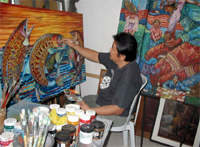
Beyond Colors and Strokes are Messages of Dreams and HopesBy Gingging Avellanosa-Valle At one glance of his artwork, there is no mistaking the strokes. Vivid and even lucid in his presentation of the indigenous characters, Bert Monterona’s art can not but arrest attention and focus.
amateur photojournalist out on a Fact Finding Mission with non-government organizations in Davao City, who bravely trooped to Laac, a far-flung municipality of Davao del Norte to find out facts about reported human rights violations committed by men in uniform. The team had a big laugh later despite our fears because when the time came to have our films processed, what Bert got was not a rolling APC, but an empty box of Kodak film that he tossed away when he tried to hastily load his camera right smack in the middle of his frame, as everyone ran to look around for cover. While he was out there braving the awesome sight of APC the rest of us scattered to different huts and cramped ourselves into small holes under the houses the people in the community call “foxholes”. But that was another story. I knew Bert then not as an artist but as a Human Rights advocate. I was fully aware of his art work then, but I was not an enthusiast of his kind of art. I even often saw what we call way back in our college days as “art for art’s sake” in his works, my mind having been set on what so-called student activists of those days defined as “art for the masses”. Back then, I could only appreciate art in black and white. And though I have been aware of Bert’s many accomplishments
through the years, these did not seem to impress me. Then late in
the 90s, I became exposed to some of his murals in a school I was
connected with. Incidentally, I had to view these murals and make
mental assessments, and little by little, my attention was drawn
to each of his works, and I began to notice. There was something
there in those art works that comes through to me but I could not
quite define. These wonderings found some answers when Bert and I met sometime in 2002, when he was having a Summer Art Workshop for children in one of the schools in Davao City. Much later, I also learned from him that his roots, his Lola and his mother whose linage were among the Bukidnon tribe, were and still are the very inspiration of all his art pieces. “I was inspired by my childhood experiences, when we would hunt wild animals for game, chase birds in the forests, find wild berries and play with monkeys up in the trees… beautiful memories that linger even when the forest in my childhood began to disappear, like the nurturing love of my grandmother who has kept me going even when she is long gone. These all fueled my inspiration,” he intimated.He was only six (6) years old when Bert started to make illustrations and drawings of cow boys on the t-shirts of his playmates back in Bukidnon, while listening to the radio drama “Diego Salvador” that was the favorite pastime of people in the barrio, he related. Kids would seek him out in his Lola’s store and have him draw on their backs while they listened to the radio drama, and it would make their day complete. “Lumad art is my life and my experience, it is my culture and my struggles. It is an instrument that would bring respect for the Indigenous Peoples, so that they be given proper attention just like other peoples in Mindanao,” he said quietly, even as he said it is not easy to make a living as an artist, especially in these days and time. “Even the art collectors and the capitalists do not anymore make art as a priority in their budgets,” he shook his head. His summer art workshops have helped him though, to prepare for the studies of his two children who are both in school. He also earned from the art work he was commissioned to do by business establishments in the city who liked his strokes and his themes. DreamsAnd his dreams continue in his art pieces, even when he recognizes that his art works depicting reality in the past, of verdant forests and happy faces of the Indigenous Peoples have become but mere pigment of the imagination, as the forests continue to be denuded and the Indigenous Peoples’ deprived of their ancestral domain. With the full support of his wonderful family, his wife Lourdes who lost no time to assist him in his undertakings, and his two children Bernie Lou, 15, whom Bert saw an inclination to follow his footsteps; and Monna Lou, 10, both of whom are attending to their studies while giving their father the inspiration to continue his dreams, there is no stopping this prolific artist from making painting his all, even at times when daily living calls for stringent measures. The countless art exhibitions, lectures and other endeavors (which are too many to enumerate) here and abroad tell about Bert’s untiring devotion to his art and the seemingly bottomless, nay boundless, inspiration he seems to possess. The latest exposure of his art works in 2004 outside the Philippines was the “ Myriad of Multiples” A juried show of British Columbia Artists, held in the Main Gallery of Simon Fraser University, Burnaby, British Columbia, Canada. Barely did he came back home when another activity was awaiting him and his collections. “Hulagway sa Panaw” Mindanao Reality Check: Contrasts in Dreams, is a homecoming art exhibition that he is mounting in July 2005 for the benefit of the Children’s Rehabilitation Center, (CRC), where he said he once worked with in 1986-1988 as art educator in CRC’s Art Therapy workshop. Co-presenters of these art exhibition include the City Mayor’s office of Davao City, the NCCC Mall of Davao, the People Collaborating for Environment and Economic Management (PCEEM) and the Mindanao Interfaith People’s Conference, (MIPC). This is going to be formally launched on July 8, 2005 and will run on for the whole month of July.
|