| ARTICLES:
Beyond Colors and Strokes are Messages
of Dreams and Hopes
By Gingging Avellanosa-Valle
07-02-2005
------
The Fil-Canuck-Chilean
Connection
By Alfred A. Yuson
The Philippine STAR
10/04/2004
------
On the Works of Bert Monterona:"Can a Man be a Feminist?"
By Alan Haig-Brown
Mindanao Culture
2004
------ |
On the Works of Bert Monterona:
"Can a Man be a Feminist?"
By Alan Haig-Brown
 I
have heard it said that the feminist movement is a creation of western
white middle class women and so does not serve the needs of women of
colour and other women who do not share the same privileged place of
those who do most of the writing and other creative work on the subject
of feminism. I
have heard it said that the feminist movement is a creation of western
white middle class women and so does not serve the needs of women of
colour and other women who do not share the same privileged place of
those who do most of the writing and other creative work on the subject
of feminism.
Another debate that has presented
itself in relation to the topic of feminism argues the validity of
men's place in expressing or professing feminist ideals. In short, "Can
a man be a feminist?"
It has even been said that the export of western feminism is yet another example of western colonization.
Bert
Monterona's newly opened exhibition at Simon Fraser University's art
gallery in Burnaby, a suburb of Vancouver, opens up some large spaces
for discussion about each of these contentions. A native of Mindanao in
the Philippines with aboriginal blood and perspectives, Bert has
created large canvases (They are actually cloth which he laughingly
invites people to touch in contravention of gallery rules and
etiquette) that tell the story of the colonization of Mindanao. Many of
these recognize a history that has been expressed as "300 years in the
Vatican and 50 years in Hollywood."
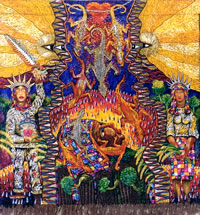 A
wonderful example of the cultural genocide that accompanies
colonization is included as a small part of one of Bert's typically
large and complex tapestries. In the illustration, an indigenous
Mindanao person holds an apple from which radiates the same
illumination that we recognize from countless images of the Sacred
Heart of Jesus. But it is not a heart, it is a red apple. The notes
accompanying the picture explaining that no indigenous language has
ever been taught in a school in Mindanao. At the same time, even though
no apples grow in the Philippines, children are taught their ABCs with,
"A is for Apple." A
wonderful example of the cultural genocide that accompanies
colonization is included as a small part of one of Bert's typically
large and complex tapestries. In the illustration, an indigenous
Mindanao person holds an apple from which radiates the same
illumination that we recognize from countless images of the Sacred
Heart of Jesus. But it is not a heart, it is a red apple. The notes
accompanying the picture explaining that no indigenous language has
ever been taught in a school in Mindanao. At the same time, even though
no apples grow in the Philippines, children are taught their ABCs with,
"A is for Apple."
This is a smart critique of
colonization in which one would hope Canadian viewers will recognize
our own complicity through indigenous education in our country.
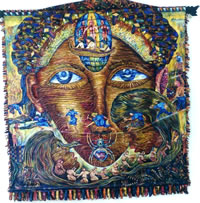 The
huge importance of the issues of colonization have not limited Bert
from commenting on the shamefully restricted role of women in
Philippine culture. He avoids the simple traps of "honouring" women
that generations of western artists have fallen into from the sweet
Madonnas of the Renaissance to contemporary artists' nudes that seek to
make women some exemplary but unattainable earth mother or sexual
goddess. Bert shows women carrying the tools of their trade, from
cooking pots to millinery shears, walking across a tight rope in a
tenuous attempt to reach some stage where respect will reward them for
their perseverance if not for their reality. The tight rope is a
striking metaphor and condemnation of all men, western and Asian, who
continue to allow this exploitation on all levels from gilded cages of
marriage to the plastic opulence of the bordello. The
huge importance of the issues of colonization have not limited Bert
from commenting on the shamefully restricted role of women in
Philippine culture. He avoids the simple traps of "honouring" women
that generations of western artists have fallen into from the sweet
Madonnas of the Renaissance to contemporary artists' nudes that seek to
make women some exemplary but unattainable earth mother or sexual
goddess. Bert shows women carrying the tools of their trade, from
cooking pots to millinery shears, walking across a tight rope in a
tenuous attempt to reach some stage where respect will reward them for
their perseverance if not for their reality. The tight rope is a
striking metaphor and condemnation of all men, western and Asian, who
continue to allow this exploitation on all levels from gilded cages of
marriage to the plastic opulence of the bordello.
"Can a man be a feminist?"
This
privileged white western male won't attempt the answer, but I will
admit to tears at Bert Monterona's vibrant expression of the issues.
Original article can be found here.
Photos by Alan Haig-Brown |