 |
 |
 |
 |
 |
 |
 |
 |
 |
 |
 |
 |
 |
| ARTICLES: Beyond Colors and Strokes are Messages of Dreams and Hopes By Gingging Avellanosa-Valle ------ The Fil-Canuck-Chilean Connection By Alfred A. Yuson ------ On the Works of Bert Monterona:"Can a Man be a Feminist?" By Alan Haig-Brown ------
|
The Fil-Canuck-Chilean Connection By Alfred A. Yuson
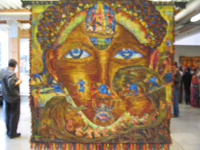
It was Charlene Sayo of the Fil-Canadian Youth alliance who issued a verbal invite to an art exhibit opening at the University of British Columbia. We were at one of those ubiquitous Starbucks outlets in downtown Vancouver, a feature of laidback commonality shared with Metro Manila. In fact I felt like I was sipping cappuccino on a busy part of the Katipunan strip across Ateneo, except for a view of trees and that ever-ardent personal wish for an end to Bayani Fernando’s petty version of totalitarianism. Charlene’s brother Carlo seconded the invite. Filipino groups like theirs were supporting the art show, as it featured the work of Bert Monterona of Davao City. A no-brainer. Sure, I’ll take the family along. We had really planned on checking out UBC. No telling how long the Blue Eagles back home may miss out on another UAAP basketball crown; the wait could get boring. All we had to do was ask for the C.K. Choi Bldg., which housed the UBC Institute of Asian Research. Filipino professor Leonora Angeles had helped arrange for the lobby set-up for "Magnifying Mindanao: A Monterona Art Exhibition (Sept. 7 — 17)." We arrived more than an hour early for the opening rites, a cab depositing us right at the Institute’s doorstep. But not before we had noted with appreciation how lovely and inviting the campus was, verdant and brimming with lebensraum. Wide open spaces, excellent roads with little traffic, gardenscapes utterly quiet, and with but small groups of students walking to and fro with apparent sobriety of purpose. Stepping into the lobby, we were greeted by another eye-opener. Monterona’s large wall hangings immediately astounded with their glorious bursts of tropical colors and intricate mélange of familiar, indigenous forms. Some were hung back to back, suspended from the low ceiling. Each one arrested the eye and beckoned for closer intrigue. The canvases appeared to be a cross between bark and tough cloth, horizontal edges framed with vine or unraveling into wild tassels. Indeed, tribal Mindanao had crossed the Pacific. The artist came forward and introduced himself as a cross-regional colleague of our dear departed friend Santi Bose. Bert said Santi had visited Davao and they had experienced instant rapport, what with their common vision of lofting native icons, motifs, materials, historiography and everyday pageantry into distinctive works of art.
From 1996 to 2001, he had served as the Mindanao Coordinator for the National Commission for Culture & the Arts or NCCA. Over a year ago he traveled with a group of Mindanao artists on a workshop grant, bringing their art to Canada. And he had stayed on, attracted by the possibility of sharing (and enhancing) his art experience with both Western artists and the distinguished lot that represented the First Nation communities. The exhibit brochure said it all: "As an art educator, he organized and facilitated art workshops in schools and tribal communities, from skills development to art as therapy and livelihood project. As a grassroots researcher, he documents the use of indigenous art materials and processes, and brings his works from museums and galleries to the streets, urban poor and indigenous communities." Bert has been staying with a Canadian academic who has become a foster father of sorts. Allowed to experiment with the professor’s extensive garden, he has turned it into a terraced landscape that spells living art. He’s planning another exhibit, this time at the Simon Fraser University, before he finally comes home late in October. Most of his tapestries are not for sale. One did get away, on the combined strength of determined cajoling and financial temptation. And it had pained him to part with his work, Bert said. What’s wrong with that, I asked. You can always replace it with a new piece. In fact it could spur you on to produce more of these extraordinary specimens, as a continuing celebration of your obvious genius. But no, he said, he wanted to bring back everything to Mindanao, where they "belonged." Only the smaller works, the more conventional oil paintings, would be left behind in Canada as a modest collection. Bert represents to the full the Filipino artist at home abroad, or anywhere he can find material/s and inspiration to indulge his superlative talents. It is as if these outstanding artists carry with them inexhaustible personal founts of ideas which, attended by excellent craft and a view to stay true to the "globalized self," set fire to increasingly appreciative parts of the known world. This was evident from the remarks made by Michael Leaf, the UBC Center for Southeast Asian Research director; Timothy Clock, acting director of the host institute; Sneja Gunew, director of the UBC Center for Research on Women’s Studies and Gender Relations; and Wendy Frisby, chair of the UBC Women’s Studies Program. All were in accord as to the guest artist’s invaluable contribution to world art, and to Vancouver’s current art scene in particular. Wrote Carol Forbes: "Created from dye, textile paint and acrylic, the tapestries look and feel like hand-woven cloths and artifacts from South East Asia’s past."Another art reviewer, Alan Haig-Brown, extols the very same virtues that women’s studies specialists hail in Monterona’s work: "He avoids the simple traps of ‘honoring’ women that generations of Western artists have fallen into, from the sweet Madonnas of the Renaissance to contemporary artists’ nudes that seek to make women some exemplary but unattainable earth mother or sexual goddess. Bert shows women carrying the tools of their trade, from cooking pots to millinery shears, walking across a tightrope in a tenuous attempt t reach some stage where respect will reward them for their perseverance if not for their reality." Bravo, Bert! It certainly felt good to bask in Bert Monterona’s success, among equally elated ka-tribo and many new friend in the Fil-Canuck community. Especially while feasting on lumpia, ukoy and pancit, and enjoying as well the arnis and dance performances by a gorgeously clad and rather athletic Pinoy troupe, to the beat, twang and hiss of drums, hegalong (a la Ayala, Joey) and rainsticks. Late-summer twilight wouldn’t be until past eight, so we
had time to patrol the campus, check out the impressive library
with freebie Internet use even for "guests." Thence the
"rec" center that is the second gym, to appraise the local
basketball talent. The 16-year-old varsity trainee with us quickly
remarked that only three guys on the practice floor, which had multiple
half-courts, could give him a bit of a sweat. The "Hongcouverites"
seemed easy pickings. Plucking a loose ball, he made himself feel
at home with treys and twisting lay-ups, which soon earned him an
invite to a pick-up game with a mostly pan-Asian contingent. So
it was back to the "lib" and nba.com, yahoo, google, etc,
for the rest of the family. Till twilight, and the No. 2 bus for
downtown. The kids were also quite impressed with the city library, all
seven floors gracefully rising as Po-Mo architecture, glass-encased
as seen from the central atrium of chock-a-block cafés, but
resembling a Roman coliseum from a landmark vantage. Again, Internet
use was free, but non-lib cardholders were limited to half-an-hour’s
use. And one had to do it standing up; no stools for transients! Shifting from English to Spanish, he keeps mentioning 9/11, and I remember that we’re due to fly out on that date. Surely he isn’t trying to strike paranoia in my fatherly heart. Thankfully, the flight time would be close to midnight, so that whatever terrorist commemoration may be attempted would probably just close down airports, and not catch us in mid-flight. Turns out that Alejandro’s harking back to an earlier 9/11 event, the assassination of Salvador Allende in his home country, which led to his own incarceration by the putschists. He does not forget what eventually caused his exile. He remains forever impassioned about it in his poetry. I confess that I know next to nothing other than the U.S. account of that event that had changed his life. I offer in turn to read a poem occasioned by the centenary of Pablo Neruda. The same poem I would read barely three weeks later, this time
back home, at the Instituto Cervantes’ tribute to Neruda at
DLSU’s Gaerlan Conservatorio. That evening, F. Sionil Jose
is also feted by the Chilean Ambassador with the Neruda Prize. I
take care of dear Frankie’s requisite photo-ops. I should
remind him one of these days: if Pablo had his Isla Negra, shouldn’t
I be rewarded, in exchange for glossy prints of a historic moment,
with bottles of cerveza negra? Salud, Cesare!
|